


Education in an Age of Control: Why True Learning Requires Inner Freedom
- Samuel Kaitter
- Jan 23
- 5 min read

Introduction: The Changing Landscape of Education
Education in 2026 is not just about reading, writing, and arithmetic — it’s also about navigating a landscape shaped by powerful external forces, from federal policy shifts to accountability mandates and social pressures. These trends can unintentionally incentivize compliance, competition, and conformity over curiosity, creativity, and emotional agency.
At the heart of this shift lies a tension between external control and internal freedom — and understanding that tension is essential if we want students to remain independent, critically engaged, and emotionally sovereign learners.
Federal Policy and Its Impact on Local Education
In the United States, education has historically been shaped by a complex balance of federal, state, and local influence. Though the federal government contributes a smaller share of overall funding than state and local sources, it still plays a powerful role in shaping policy — especially through rules and accountability frameworks attached to federal funds.
In recent years this role has been evolving:
Federal enforcement actions — including civil rights investigations into harassment, discrimination, and Title IX compliance — have reached record levels, indicating a heightened federal presence in educational environments.
In recent years, federal enforcement actions in education have expanded significantly, reflecting a growing emphasis on oversight, equity, and accountability in school systems across the United States. Agencies such as the U.S. Department of Education’s Office for Civil Rights (OCR) have launched a record number of investigations into issues like discrimination, disability access, sexual harassment, and Title IX violations. This surge stems from nationwide efforts to ensure safe and inclusive learning environments, yet it also signals a heightened federal footprint in local education systems.
While many of these actions are rooted in protecting students’ rights and ensuring fairness, they also create a new atmosphere of compliance and caution within schools. Administrators face mounting pressure to meet federal expectations, document procedures meticulously, and respond swiftly to regulatory inquiries — sometimes at the expense of creative teaching and student connection. For students, this can subtly shift the emotional climate of learning, where fear of saying or doing the “wrong” thing replaces open dialogue and authentic exploration.
This trend underscores a pivotal question for educators and policymakers alike: how can we balance necessary oversight with the freedom, trust, and psychological safety required for true learning to flourish?

Federal policy volatility has made nearly 40% of educators reconsider whether to stay in their roles, according to a 2025 Education Week Research Center survey, reflecting growing uncertainty and systemic stress in school communities.
New executive actions like Executive Order 14190, aimed at restricting certain curricular content at the federal level, demonstrate ongoing debates over who controls teaching and what that content should be.
These trends highlight a broader environment in which external mandates and enforcement pressures are increasing, even as educators and leaders advocate for greater flexibility and localized decision-making.
Standardization and Accountability: When Structure Becomes Constraint
One of the most widely discussed federal influences on education has been the legacy of standardized assessments and accountability systems. Starting with the No Child Left Behind Act and continuing under the Every Student Succeeds Act (ESSA), federal policy has required annual testing and reporting that, while intended to ensure equity and quality, can shift focus toward measurable outputs rather than deep learning.
Critics have long argued that high-stakes testing and accountability can narrow curricula, discourage risk-taking, and reduce learning to numbers — undermining trust and psychological safety in classrooms.
These pressures — while designed to ensure standards — can inadvertently signal to students that external measures of success matter more than their own authentic understanding or internal growth.
Policy Actions and Student Well-Being
Beyond testing and curriculum debates, broader enforcement actions have ripple effects on student experience:
Heightened immigration enforcement has been linked to significant drops in attendance for English learners, effectively reducing access to educational opportunities for certain populations.
Policy disputes over culturally relevant curricula and federal funding threats have created confusion and anxiety among educators and families alike, complicating efforts to build stable, supportive learning environments.
These systemic stresses contribute to an education environment where external pressures can overshadow students’ sense of security, belonging, and internal motivation — all critical components of meaningful learning.
Why Inner Sovereignty Matters More Than Ever
As external pressures increase — whether through policy, accountability systems, or sociopolitical controversy — young learners risk living in a state of reactive conformity rather than proactive growth.
This is where Determined Student Success (DSS) — with its emphasis on internal sovereignty and psychological safety — becomes not just helpful, but necessary.
True learning requires more than compliance with standards; it thrives in spaces where students feel safe to think deeply, make mistakes, reflect authentically, and trust their own inner guidance. Psychological safety enables learners to navigate external expectations with resilience, creativity, and self-determination.
Where Trends Are Headed: Toward Human-Centered Reform
Current trends in education — including discussions about federal oversight, workforce shortages, and the role of technology and well-being in schools — reveal a system in flux.
While policies will continue to shape the structures students and educators operate within, there is growing recognition that learning cannot be reduced to compliance or measurement alone. Students must learn to:
Think critically about systems and policies.
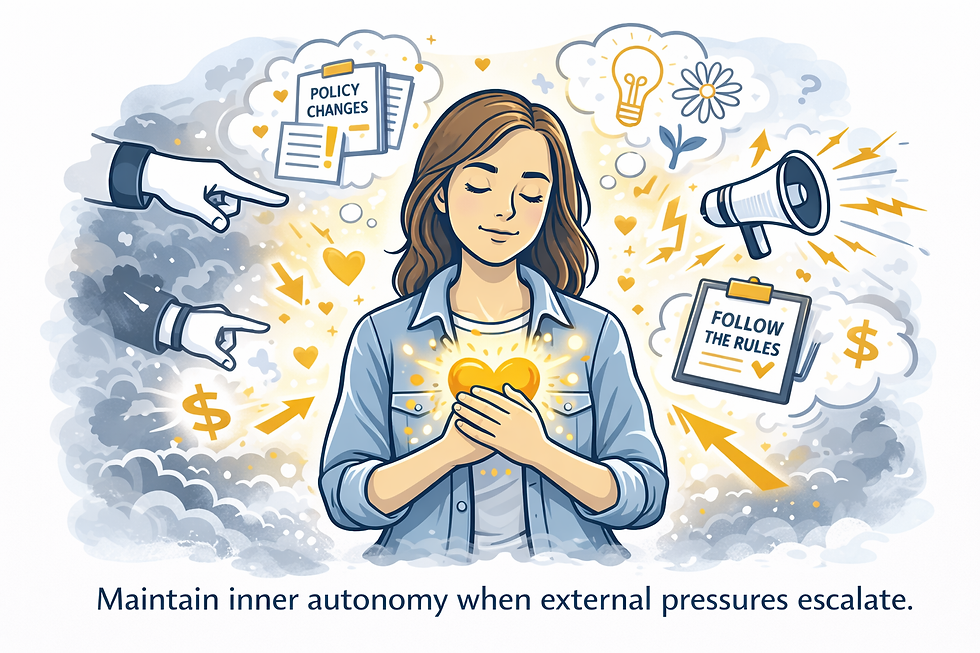
Maintain inner autonomy when external pressures escalate.
Cultivate emotional intelligence alongside academic skills.
Ground their learning in meaning, not metrics.
The DSS Vision: Conscious Resistance and Compassionate Reform
DSS advocates for an education that supports internal freedom alongside academic achievement. This isn’t about rejecting standards — it’s about ensuring that students develop the psychological and emotional foundations to thrive within, around, and beyond those standards.
Practically, this means:
Teaching reflection and heart-centered self-awareness as core practices in learning.
Equipping students to form actionable plans based on their values and purpose.
Balancing external expectations with internal empowerment.
Creating ecosystems where students are active participants, not passive recipients.
Conclusion: Restoring the Heart in Education
Federal policy, enforcement, and standardization are not inherently negative — but when systems neglect the human element of learning, students can lose their sense of agency and worth.
The future of education must value both structure and soul — measurable success and meaningful growth. To achieve this balance, we must anchor learning in inner sovereignty, emotional safety, and reflective agency, enabling students to flourish as autonomous, compassionate, and purpose-driven learners even amidst external pressures.


Comments